
Rather than being a condition with a clear ‘start’ and ‘end’, OA manifests as a continuum, evolving over time due to injury, anatomical predisposition, repetitive microtrauma, and systemic influences such as obesity. It requires patience and persistence: there are no quick fixes.
The push for lifelong management rather than episodic care is driven by:
- The need to minimise chronic pain, which is multidimensional and often worsens over time.
- The importance to address associated comorbidities and prevent secondary complications.
- Recognising the “early onset challenge,” where OA begins subtly, often going undiagnosed until significant changes have occurred.
- The phasic nature of OA progression, wherein the disease and clinical presentation wax and wane, but pathology may be advancing insidiously.
- The ever-expanding understanding that targeted interventions, applied early and continuously, may slow or partially reverse pathologies—specifically in soft tissues, neural elements, and metabolic contributors.
Thus, managing OA is less about treating isolated flare-ups and more about constructing a care plan designed to adapt and evolve alongside the animal’s disease journey.
OA does not progress in a linear or uniform fashion. Rather, it is a journey marked by:
- Periodic episodes of acute pain.
- Mixtures of acute and chronic clinical presentations.
- Prolonged periods of persistent pain, sometimes (but not always) escalating into advanced chronic pain syndromes and severe mobility loss.
The “disease journey” model involves the key transitions:
- Interplay of Pathologies: OA-driven changes such as cartilage degradation, bone sclerosis, synovial inflammation, neural upregulation, and muscle wasting combine to create not just local pain but systemic frailty and functional decline.
- Lameness and Behavioural Changes: Owners and clinicians must recognise that OA’s clinical signs, such as lameness, may be intermittent but almost always signal underlying, ongoing injury to the joint and its associated structures.
- Episodic and Persistent Pain: OA may begin with episodic, acute flares, perhaps following trauma, overuse, or cold weather, before consolidating into more continuous discomfort.
- End Stage Joint Injury: The terminal outcome of unchecked OA, resulting in catastrophic lameness or disability that necessitates radical interventions like surgery or, in some cases, euthanasia.
Early identification and sustained, proactive management can forestall the most severe outcomes, making recognition of early and subtle signs critical.
Tracking progress is paramount, both to validate efficacy and course-correct where improvement is lacking. Several measures are recommended:
- Objective scores: Clinical evaluation, digital pain and mobility indices, LOAD (Liverpool Osteoarthritis in Dogs), and owner-reported outcomes.
- Recorded trends: Consistent documentation allows for comparative, longitudinal assessment.
- Addressing the “Caregiver Placebo Effect”: Owners must be guided to recognize subtle deficits, rather than over-report improvement due to wishful thinking.
Regular re-assessments are key—both for clinical review and empowered owner feedback.
Long-term OA management is built on:
- A structured, staged process (the CCM and Tri-Sector systems).
- Embedding process and skills throughout the veterinary team.
- Utilizing validated tools and resources developed by organizations like VOA.
- Ensuring continuity through practices like Mobility Clinics.
- Frequent monitoring and owner partnership.
- Open, ongoing education at every step.
Success is measured by an animal’s comfort, function, and preserved quality of life.
7.1 Control, Consolidate, Maintain: identifying optimal treatments for the disease stage and individual
The management of OA, particularly over the lifetime of an affected animal and across patient cohorts, demands a systematic approach. The CCM system (Control, Consolidate, Maintain) aims to meet the challenge of chronicity head-on: OA is incurable, but its effects can be mitigated. It helps us to deploy smarter management choices using structured assessment tools—Tri-Sector Assessment being central among them. These elements work together, ensuring that every animal receives an individualised, evidence-based, and adaptable care plan.
The Control-Consolidate-Maintain (CCM) System represents a straightforward, dynamic model for managing OA in clinical practice and is highly adaptable for general and specialist practitioners alike.
It is critical that every OA patient is assigned to a CCM phase, and clinicians adapt management as the case evolves.
7.2 Dynamic Transitions and Decision-Making
Patients may transition forward or backward through these phases, and clinicians must be vigilant for cues suggesting reassessment is required—a sudden pain spike, progression of lameness, or behavioural change can signal the need to revert from Maintain or Consolidate back to Control.
As the disease progresses, management strategies must adjust—what works in the early “reactive” or control stage may need to be supplemented or substituted as pain becomes persistent and more complex. For advanced cases, especially those with intractable neuropathic pain or catastrophic joint failure, the focus may shift to support, palliative care, surgery, or even end-of-life decision-making.
Analgesic strategies may progress from simple NSAIDs and adjuncts, to advanced centrally-acting agents, monoclonal antibodies, and regenerative techniques. Stable “active” and “passive” states should be replaced by a genuinely preventative ethos, focusing on early interventions, continuous monitoring, and owner partnership.
For the system to work, owner buy-in is paramount:
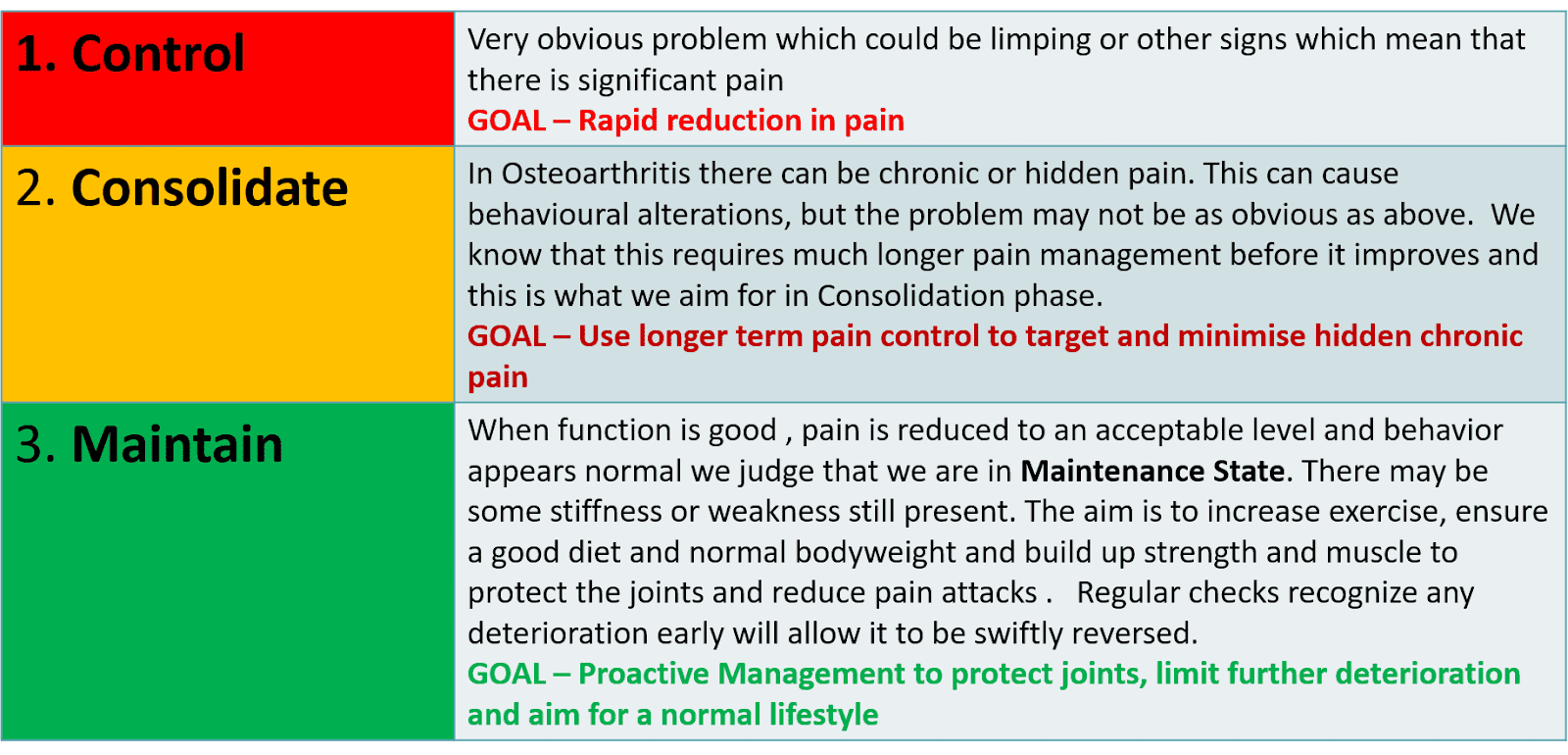
- Control Phase: Owners are educated to identify significant pain/lameness, understand the importance of rapid control, and comply with close follow-ups.
- Consolidate Phase: Owners learn to look for subtle behavioural changes and are prepared for a longer duration, multi-modal management plan.
- Maintain Phase: Emphasis is on sustaining improvement, optimising nutrition, weight, and activity, with regular checks to detect deterioration early.
Open communication, supported by written plans and handouts, helps owners become effective partners, not just passive observers.
Table 8 Owner Information describing the dynamic clinical phases of OA
References and Further Reading
- Loeser RF et al (2012) Osteoarthritis. A Disease of the Joint as an Organ. Arthritis and Rheumatism 64; 1697-1707
- Fox SM (2014) Chap 6 p 155-184 in Pain Management in Small Animal Medicine. Pub CRC Press , Tayor and Francis Group, FL www.taylorandfrancis.com
- Sartini I and Giorgi M (2021) Grapiprant: A Snapshot of the current knowledge. Vet Pharm Therap 44;679-688
- Reid J, Gildea E, Davies V, Thompson J and Scott M (2024) Measuring the effect of the anti-nerve growth factor antibodies bedinvetmab and frunevetmab on quality of life in dogs and cats with osteoarthritis using a validated health-related quality of life outcome measure: an observational real-world study. Front. Vet. Sci. 11:1395360.doi: 10.3389/fvets.2024.1395360
- Chandler R (2025) Regenerative Medicine in Small Animal Musculoskeletal Conditions. Pub 5M Books Ltd, Essex, London. www.5mbooks.com
- Barnhard JA et al (2025) Owner-reported outcomes indicate intra-articular 2.5% polyacrylamide hydrogel injection is well tolerated and reduces osteoarthritis signs in dogs
AVMA doi.org/10.2460/javma.25.06.0398
- Arno MG et al (2026) Tin-117m radiosynoviorthesis safely and effectively manages
canine osteoarthritis with minimal radiation exposure:
a narrative review JAVMA January 7, 2026 doi.org/10.2460/javma.25.08.0564
- Brookes W, Payne R and Lea R (2024) Reporting outcome measures in veterinary physiotherapy with particular reference to the treatment of canine and equine joint cases in the UK Vet Rec. 2024;e3900. https://doi.org/10.1002/vetr.3900
- T. Cachon, O. Frykman, J.F. Innes, B.D.X. Lascelles, M. Okumura, P. Sousa, F. Staffieri, P.V. Steagall, B. Van Ryssen (2018) Face validity of a proposed tool for staging canine osteoarthritis: Canine OsteoArthritis Staging Tool (COAST). The Veterinary Journal 235(18): 1-8 https://doi.org/10.1016/j.tvjl.2018.02.017
T. Cachon, O. Frykman, J.F. Innes, B.D.X. Lascelles, M. Okumura, P. Sousa, F. Staffieri, P.V. Steagall, B. Van Ryssen (2023) COAST Development Group’s international consensus guidelines for the treatment of canine osteoarthritis Frontiers in Veterinary Science 10: https://doi.org/10.3389/fvets.2023.1137888